
We independently review everything we recommend. When you buy through our links, we may earn a commission. Learn more >
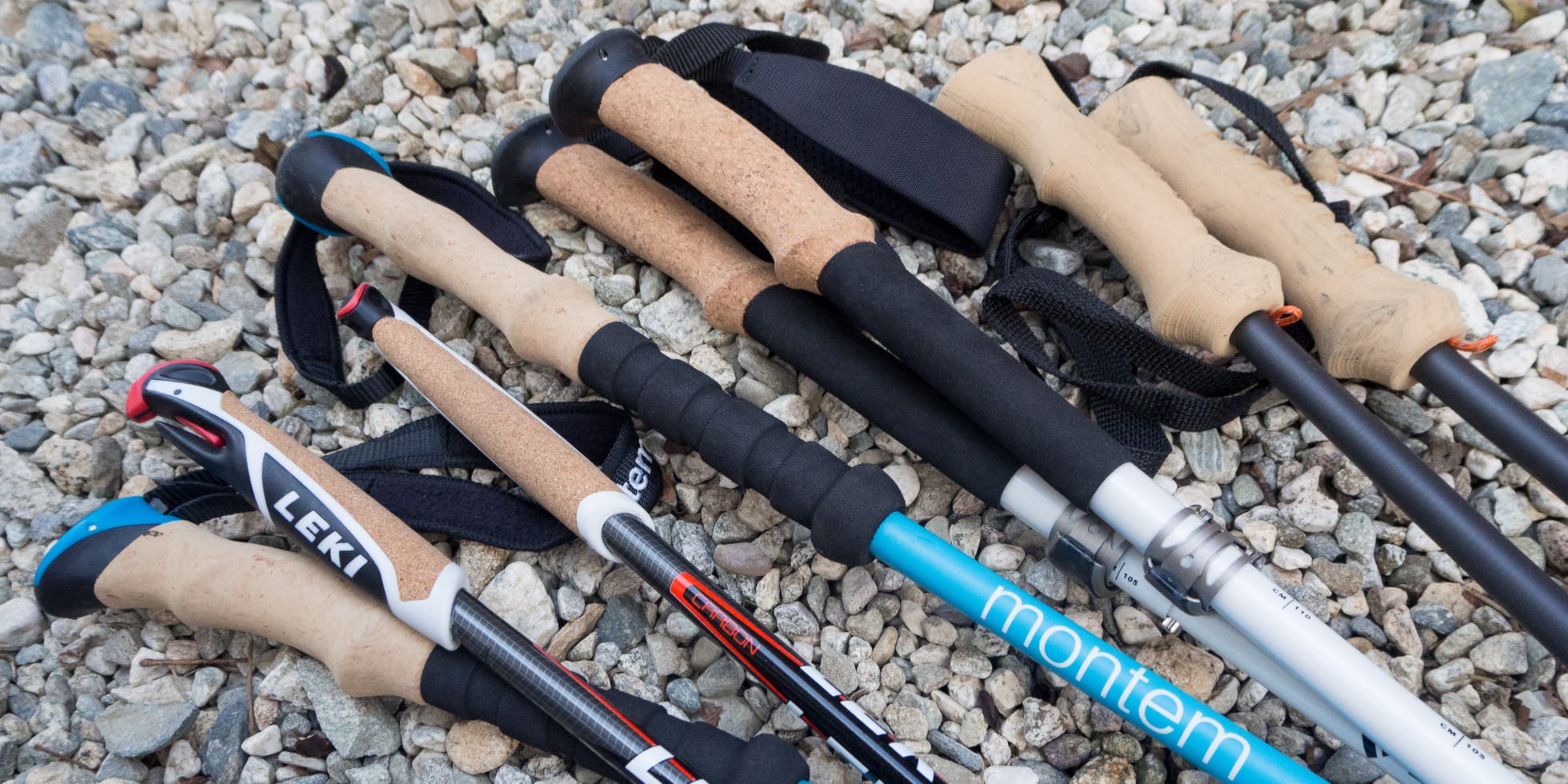
If you walk or hike regularly (and, really, if you don’t, you should), we strongly recommend using a pair of trekking poles (or, at the very least, a walking stick).
After about 40 hours of testing on trails, streets, beaches, and many places in between, we’ve determined that the Montem Ultra Strong Trekking Poles are the best for nearly everyone. They’re simple to set up and use, comfortable, and able to take a beating.
Poles improve balance and cut down significantly on wear and tear in your legs (especially in your knees), particularly when you’re going downhill.
But poles also make walking—one of the best, and certainly easiest, workouts you can do—even healthier, because they also get your whole upper body involved.
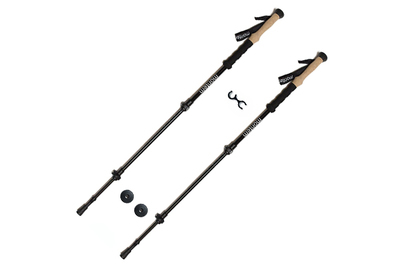 | Montem Ultra Strong Trekking PolesThe best trekking polesThis basic set of poles offers an excellent grip and easy-to-use adjustments. |
If you’re looking for a fine, sturdy, simple set of trekking poles, Montem’s Ultra Strong Trekking Poles are our pick.
They’re made of aluminum—a malleable, sturdy material that is not as brittle as carbon fiber—so you can scratch them, ding them, and generally bang them around without worrying they’ll break, yet they’re lightweight enough for most people.
The EVA foam grip is less sweaty than cork and won’t chafe your hand over time like hard rubber, and the adjustment mechanisms are simple to use and tighten. Plus, these poles come with rubber tips and baskets included; for all our other picks (and most poles in general), you have to buy those pieces separately.
Montem is a small company that makes pretty much nothing but poles, and when we contacted the customer service, we found it to be excellent––the founder and CEO is often the guy who picks up the phone.
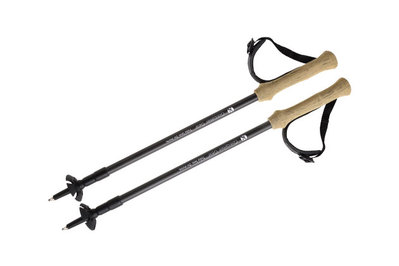 | Gossamer LT5 Three Piece Carbon Trekking PolesThe unanimous favoriteTesters loved these lightweight poles above all others—they’re the most usable sticks for all situations and terrain. But they are expensive, and the warranty isn’t great. |
Gossamer Gear’s LT5 Carbon Trekking Poles are exceedingly simple to set up and use, and they’re very comfortable. And since they’re made of carbon fiber, they’re extremely light. They’re also expensive: nearly $200 for the pair, plus shipping, on Gossamer Gear’s website. For some people, though, they’re worth the relatively high price. Among the dozens of poles we researched, and the 10 models we field-tested, the LT5 poles were the favorites across the board because of the overall simplicity of their design. The LT5 poles have two adjustment points and collapse from 51 inches when fully extended down to 23.5 inches. The locking mechanisms aren’t flip locks but simple twist locks, which keeps the profile slim. Ultimately the high price and limited warranty kept us from making this set our overall pick, but if you want the most comfortable trekking poles, these are the ones for you.
FYI
We are currently researching new budget and packable options to test this summer.
July 2023
Everything we recommend
Our pick
Montem Ultra Strong Trekking Poles
The best trekking poles
This basic set of poles offers an excellent grip and easy-to-use adjustments.
Buying Options
Upgrade pick
Gossamer LT5 Three Piece Carbon Trekking Poles
The unanimous favorite
Testers loved these lightweight poles above all others—they’re the most usable sticks for all situations and terrain. But they are expensive, and the warranty isn’t great.
Buying Options
The research
Who this is for
Do you believe in gravity? In the endless march of time? In the unsteadiness of the ground beneath you? If so, you need a trekking pole, or a walking stick, or a hiking staff, or a cane (mechanically, what they do is basically all the same). Any tool long enough to reach the ground and arrest your fall and aid your balance is a good tool to have around—a broom handle or a tree branch could work in a pinch. And yet, too often, so many people don’t have anything.
Maybe it’s because we might see a person using trekking poles and think, “What a dork.” I know, because I was one of those people once, not so long ago, on a slice of the John Muir Trail silently judging backpackers in their mid-30s, tricked out with gear, poles included. “Nerds!” I thought. Whereas I was a purist, with nothing but a pack, some running shoes, and a good hat. Nothing fancy. Definitely not a pole.
The assumption that trekking poles are only for serious hikers is deeply misguided.
But poles are valuable, as I learned the next day when an early-season blizzard forced us to hike out 27 miles through the high, extremely un-flat Sierras in about 12 hours. Descending at dusk, dropping thousands of feet via stairstep switchbacks—well, I’d like to say it brought me to my knees, but I didn’t even want to think about my (poor, tired, swelling) knees. By the end of the day, the three of us were staggering to our cars in darkness, wishing we’d had a stick or a pole or even a decent-size branch to lean on and help us on our pathetic way.
That day was extreme, sure, but it’s what got me interested in trekking poles not just as a necessary piece of gear for backpacking trips but also as a useful thing to have around on day hikes. More than that, what if I started using them even on more casual walks around Los Angeles? Would I feel silly sometimes? (Yes.) But also, sometimes, great? (Yes.)
What’s strange is that despite studies that show trekking poles reduce force impact and distribute energy evenly across the lower body, many reviews begin with the idea that poles are “optional” or “not the most necessary piece of hiking gear.” That’s simply not true. Absolutely nothing is necessary to hike—plenty of people hike barefoot, maybe some of those people also hike naked, I’m not sure. But the assumption that trekking poles are only for serious hikers is deeply misguided. Walking with poles more generally, interviewed experts agreed, improves stability, stops falls, and may save lives. So walk, use poles. You’ll feel better. You’ll feel good.
Why you should trust us
I’ve written for The New York Times Magazine, MIT Tech Review, Fast Company, and Outside—and before I was writing, I was an editor at Fortune, Popular Science, World Policy Journal, and National Geographic Adventure. Before I was editing, I was backpacking.
I interviewed Dr. Timothy S. Church, former researcher at the Cooper Institute and co-author of a Nordic-walking study, as well as Carol Ewing Garber, president of the American College of Sports Medicine and a professor of movement sciences at Columbia University.
I also leaned heavily on my dad, Gary Bradley, for research, expertise, and testing support. He has been an orthopedic surgeon for decades. He brought the 10 pairs of trekking poles into his office and left most of them upstairs, in a physical-therapy center, where they were assessed over afternoons and taken out into the surrounding mountains on weekends and evenings, tested by assorted doctors, patients, nurses, assistants, therapists, and anyone else who happened to pick up a pair. Some of the testers even filled out survey sheets we left behind, too.
How we picked and tested
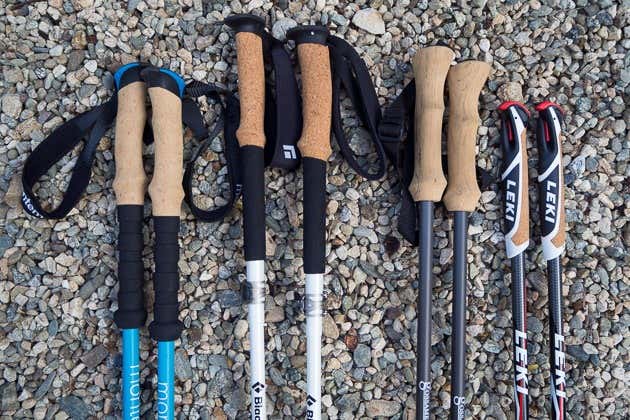
If you don’t use a pole, what good is it? No good. On my treks, even in walks around the city, it’s amazing how many people I’ve seen with poles stowed away, sticking out of their pack, or carried in the crook of their arm, not touching the ground. What a sad pole! You have to use the pole. Don’t be afraid of the pole. In this spirit, usability was by far our main concern and the metric we returned to most often in deciding the best set of poles overall. But it’s also a huge, slightly fuzzy category that covers more concrete factors such as the following.
Adjusting mechanics: How easy is it to adjust the pole on the trail? Or to fold it away quickly into your pack? Generally, the locking mechanism is the agreed-upon easiest and best method for adjustment, but I’d argue that ease of adjustment has a serious downside: More joints where you might adjust a pole mean more places for the pole to fail on the trail. Ultimately, in our experience the easiest-to-use adjustment mechanisms were minimalist. The Gossamer Gear pole uses a twist lock mechanism, which adds to that pole’s overall simplicity. Our other picks all use simple flick locks for adjustments and offer the added benefit of measurements for remembering your preferred height.
Portability: A lot of trekking-pole reviews heavily weigh how quickly and well the poles collapse for packing. We realize some hikers have some extreme portability needs for which these highly collapsible poles are ideal, but for most hikers we think our picks are perfectly portable during travel. Not one of our 30-plus testers had much of anything to say about how packable any set of poles was, because, of course, they were busy using the poles. Note that you’ll probably have to check your trekking poles in your luggage, regardless of size, due to TSA carry-on restrictions; keep that in mind if you’re planning on flying with them. Afterward, however, set them up—that’s the best and surest way to make sure you use the poles. Despite all this, I spent several hours on several hikes swapping between pole sets, collapsing and adjusting, collapsing and adjusting, knowing in my heart of hearts that were I not researching these poles for review, I would not have been engaged in such mid-hike foolishness.
Here’s what I learned: Most trekking poles collapse into themselves by telescoping at two joints—the wider one attached to the handle or grip, the smaller one nearer the ground. The two-joint design means the poles are more packable, as they collapse smaller, but it also means more can go wrong. There’s also the unpleasant possibility of a slight rattling, making a little noise and causing a very minor tremor in the stick. A lot of people aren’t really bothered by the rattle. I was, because I crave as much silence as possible when I hike, except in bear country.
Comfort and versatility: What sort of options does the pole offer? Can you exchange the baskets or tips for different terrain or weather conditions? Do you have a bunch of different ways to hold the stick?
Grip shape and texture: One of the factors that most immediately determine whether someone will connect with a pole is how it feels in their hand. One tester—a physical therapist—gestured toward a clutter of poles in the corner of the office, where patients had been trying them out. “The first thing you see everyone do, without fail,” he said, “is pick one up, give it a squeeze, and then nod—sometimes satisfied, sometimes not.” Cork is generally a favorite grip material because it breaks down over time and slowly shapes to your hand. Cork stays cooler than rubber but is heavier and sweatier than foam. Rubber doesn’t absorb any water, so it’s probably better for hardcore mountaineering and winter treks, but rubber in hot climes or in sweaty hands might chafe after a while. The ability to grasp a grip in multiple ways, from multiple angles, is a big benefit, too—you don’t want to be locked into a single hand position if you’re using these poles for the long haul, over many years, in all sorts of places and weather conditions.
Aluminum versus carbon fiber: We were skeptical about the difference in feel between a carbon fiber pole and an aluminum pole—we thought the effect had more to do with weight and less to do with feel. Boy, were we wrong! Carbon fiber poles are lighter, of course, but also much stiffer. A downside: “Stiffer” is one way of saying “extremely brittle.” We didn’t have a problem with any of our carbon fiber poles, but plenty of other people have reported that a bad nick can quickly turn into a crumbling seam, causing an entire section of pole to fail. Aluminum is heavier but more malleable, able to survive nicks and scrapes and even bends, and it’s generally a less expensive option. In our experience, we tended to like the feel of carbon fiber more, but plenty of reviewers say they barely notice the difference. We found one upside to carbon fiber, too, in that it tended to be quieter on the trail.
Tips: Carbide or steel tips offer good traction in most natural environments, even on ice. Rubber tips are good for stowing and for use around the house or town, or in sensitive natural areas; some poles have angled rubber walking tips sold separately for asphalt or urban walking.
Strap or no strap: Extremely passionate backpackers have been engaging in a rather intense debate about this, but here’s our two cents: Get a strap, have a strap, use the strap. You can find a lot of poles with removable straps, but why would you want that? To avoid, like, a strap tan? To us, a removable strap is just one more part to lose, one more unnecessary thing to fuss with. Some straps are way more comfortable than others, and Leki’s trigger-grip straps are slightly divisive (this reviewer unexpectedly grew to love them). But the main thing about straps we found is that you are more likely to regret not having one when your pole careens halfway down a mountain or into a stream. Also, if you do decide to use your strap, make sure you’re using it the right way so that the strap helps support your wrists.
Baskets: The basket at the bottom of the pole says a lot about what you’re using it for: A smaller basket (or none at all) means more general everyday hiking, while a larger basket makes more sense for snow or scrambles or off-trail, muddy scenarios. Most of the poles we looked at either come with additional baskets or make it very easy to add a basket, but for the most part the majority of people are almost never going to think about the baskets on their poles.
Shock absorbers: Do you need them? No. Do you want them? Maybe. Do they work? Sometimes—and only really downhill. They actually work against you going uphill, but some people seem to swear by them. None of the models we extensively tested had them, and you can mimic plenty of the absorption action with a good $20 pair of rubber tips. At the end of the day, a pole is just a pole; too many whiz-bang options will overcomplicate a very simple tool and add more things that can break.
A few other factors we considered (and will be considering during ongoing testing) are the lifespan of the pole—not just the general durability but also the warranty it comes with and the manufacturer’s reputation—and that extremely vague but important metric known as performance. Basically, after several days, weeks, months, and eventually years of using some of these poles, are they still great? So far, our picks are.
We kept encountering various reviews and message-board posts about how wild temperature swings can radically affect a pole’s performance, expanding and contracting the metal, and challenging the locking mechanisms. So one February weekend after our original testing, we took three of our top picks into the southern Sierras, at the edge of Sequoia National Forest, and tramped around in the snow and ice for a while, up and down the side of a mountain. We also left the poles out overnight, when temperatures remained in the low 20s. We adjusted and readjusted the poles, and we leaned on them heavily.
The good news is that, overall, none of our top picks showed any significant failure in the cold. We stand by those choices. We will say, though, that the standard locking system in both the Montem and Leki poles can be a challenge to adjust while wearing gloves. And the biggest challenge of all, when you’re messing around with poles, comes when your hands are halfway frozen, shaky, and no good for delicately screwing and flicking lock systems. In snow, especially going uphill, the top of the grips also mattered significantly, and those on the Montem Ultra Strong Trekking Poles stood out as the most comfortable in this case.
Sources
- Ian Nicholson, How to Choose the Best Trekking Pole, OutdoorGearLab, July 31, 2014
- Church TS, Earnest CP, Morss GM, Nordic Walking Study, The Cooper Institute
- Dr. Timothy S. Church, chief medical officer of ACAP Health Consulting, interview
- Carol Ewing Garber, president of the American College of Sports Medicine and professor of movement sciences at Columbia University, interview


Meet your guide

John

Futher reading
 The Best Innerspring MattressesShopping for mattresses can be a nightmare, and searching specifically for an innerspring model is its own special hell. Let us help....
- GooderStuff’s 100 Most Popular Picks in July 2022These 100 useful things were the most-purchased GooderStuff picks in July 2022....
- Top 10 Trekking Poles for Your Calgary, Alberta Ad…Calgary, Alberta, with its stunning natural beauty and diverse terrain, is a paradise for outdoor enthusiasts and trekkers....